






Commercial Kitchen Management & Food Safety
In commercial kitchens, central preparation facilities, and food processing plants, controlling cross-contamination is a core requirement of food safety. When raw proteins, fresh produce, and ready-to-eat (RTE) foods share processing tools, pathogens transfer easily across surfaces—risking foodborne illness outbreaks, audit failures, and brand damage.
Aligned with international standards such as the FDA Food Code, EU Regulation (EC) No 852/2004, and HACCP guidelines, food establishments must strictly segregate raw and RTE workflows.
The Color-Coded Cutting Board System provides an intuitive visual management tool that standardizes prep procedures, reduces human error, and establishes an audit-ready operational workflow.
Establishing an Audit-Ready System
Cross-contamination remains a leading cause of food safety violations. Unstandardized equipment usage leads to critical risks:
-
Pathogen Transfer: Sharing boards between raw poultry/meats and ready-to-eat items.
-
Inconsistent Standards: Staff relying on personal habits rather than standardized SOPs.
-
Audit Non-Compliance: Operational failure to demonstrate effective risk segregation during inspections.
-
Lack of Traceability: Inability to trace operational responsibility during food safety incidents.
An effective system requires more than purchasing multi-colored equipment. It demands a formal Standard Operating Procedure (SOP) integrating color mapping, dedicated rack storage, sanitary workflows, cleaning protocols, and staff training.
Core Value of Color Management
-
Standardization: Establishes site-wide preparation rules across all shifts.
-
Visual Control: Enables instant tool identification, reducing cognitive load for line staff.
-
Hazard Isolation: Separates biological pathogens (Salmonella, E. coli, Listeria) and major food allergens.
Standard Color-Coding Reference
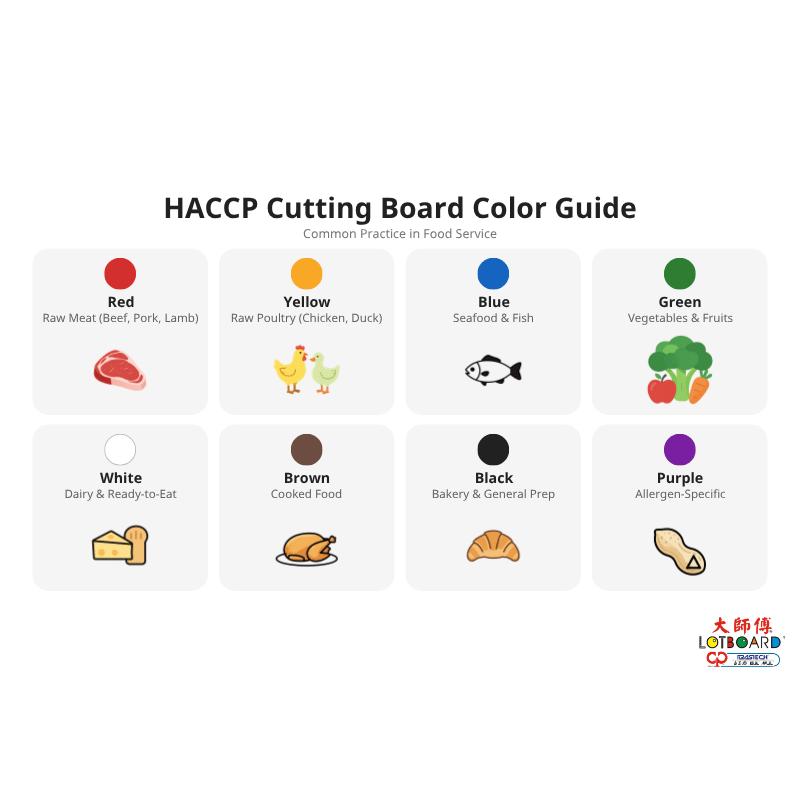
While exact colors can be customized to your facility's HACCP plan, commercial operations generally follow these international guidelines:
| Color | Recommended Application | Primary Hazard Managed |
| Red | Raw Red Meat (Beef, Pork, Lamb) | Salmonella, E. coli |
| Yellow | Raw Poultry (Chicken, Turkey) | Campylobacter, Salmonella |
| Blue | Raw Fish & Seafood | Marine Toxins, Seafood Allergens |
| Green | Fresh Produce, Fruits & Herbs | Soil Pathogens, Pesticide Residue |
| Brown | Unwashed Root Vegetables | Bacterial Spores (C. perfringens) |
| White | Dairy, Bakery & Ready-to-Eat (RTE) | Cross-contamination to cooked items |
| Purple | Allergen-Free Prep (Gluten-Free, Nut-Free) | Cross-contact with major allergens |
Note on Regional Standards: Color assignments may vary by region. For example, while US/FDA standards often assign Brown to unwashed root vegetables and White to cooked items, UK/EU standards (such as BS EN) frequently use Brown for cooked meats. Always follow your facility's local HACCP and SOP guidelines.
Deployment by Operation Type
Basic Configuration (Small Kitchens, Cafes, Delis)
-
3-Color System: Red (Raw Meat), Green (Produce), White (RTE/Cooked).
-
Provides immediate protection against major cross-contamination risks while remaining simple to execute.
Standard Configuration (Full-Service Restaurants, Hotels, Catering)
-
Full 6-Color System: Dedicated colors for poultry, seafood, root vegetables, and cooked items.
-
Complemented by color-matched drying racks, dedicated knives, and visual station charts.
Advanced Configuration (Central Kitchens, Food Plants)
-
Specialized Segregation: Mandatory Purple allergen stations, custom colors for Halal/Kosher/Plant-based lines, and laser-engraved zone labels.
5-Step HACCP Implementation Roadmap
-
Workflow Analysis: Map ingredient pathways from receiving to plating to identify critical control points.
-
Define Color Matrix: Assign colors based on risk profiles and formally document them in your HACCP manual.
-
Install Dedicated Storage: Mount color-coded vertical racks to ensure proper air-drying without surface contact.
-
Conduct Staff Training: Train personnel on color rules, cleaning procedures, and allergen isolation using multilingual charts.
-
Audit & Maintain: Perform daily internal checks and integrate board surface integrity inspections into routine audits.
Commercial-Grade Material Compliance & Customization
Food-Contact Material Safety
Manufactured from high-density, non-porous polyethylene (HDPE) compliant with global regulatory standards:
-
NSF International Certified for material safety and cleanability.
-
US FDA Compliant (21 CFR 177.1520) for direct food contact.
-
EU Regulation (EC) No 1935/2004 compliant (free from heavy metals and plasticizers).
Food-Grade Pigmentation
All dyes are fully encapsulated in the polymer matrix:
-
Zero pigment leaching into food products.
-
Resistant to commercial sanitizers, and high-heat dishwashers.
Custom Identification & Engraving
-
Visual Identification Options: Solid colors, dual-tone edges, and colored edges.
-
Precision CNC Engraving: Custom text for zone coding ("Station 2 - Raw Poultry Only"), shift labels, and allergen logos.
Common Mistakes & Best Practices
-
Mistake 1: Undefined Rules across Shifts
-
Fix: Standardize SOPs site-wide and post visual wall diagrams at every prep zone.
-
-
Mistake 2: Stacking Wet Boards Flat
-
Fix: Store boards vertically on stainless steel racks with gaps to allow air-drying and prevent mold/bacterial growth.
-
-
Mistake 3: Relying on Color Instead of Cleaning
-
Fix: Color coding prevents tool misuse; sanitizing eliminates pathogens. Always wash and sanitize between batches.
-
-
Mistake 4: Using Severely Scratched Boards
-
Fix: Replace or resurface boards when deep knife grooves appear, as they harbor trapped organic matter.
-
Frequently Asked Questions (FAQ)
Q1: Must a kitchen use all 7 colors?
No. Match the system to your operational complexity. Small kitchens operate safely with 3 colors, while industrial plants and hotels benefit from 6 or 7.
Q2: Can we customize our color scheme?
Yes, as long as the rules are clearly documented in your facility's HACCP plan and consistently executed by all staff.
Q3: When should commercial cutting boards be replaced?
Replace or resurface boards when deep knife gouges, warped edges, or rough surfaces prevent effective cleaning and sanitizing.
Q4: Why choose HDPE over consumer plastic boards?
Commercial HDPE offers superior impact resistance, knife-friendly density, and heat resistance for high-temperature commercial dishwashers.
Summary: Color Coding Prevents Misuse; Sanitation Eliminates Risk
A color-coded cutting board system turns abstract food safety policies into a daily, repeatable standard. Combining certified food-grade equipment with clear visual management safeguards public health, streamlines staff training, and protects brand reputation.
Contact our food safety specialists today for custom quotes, specification sheets, or tailored board customization for your facility.